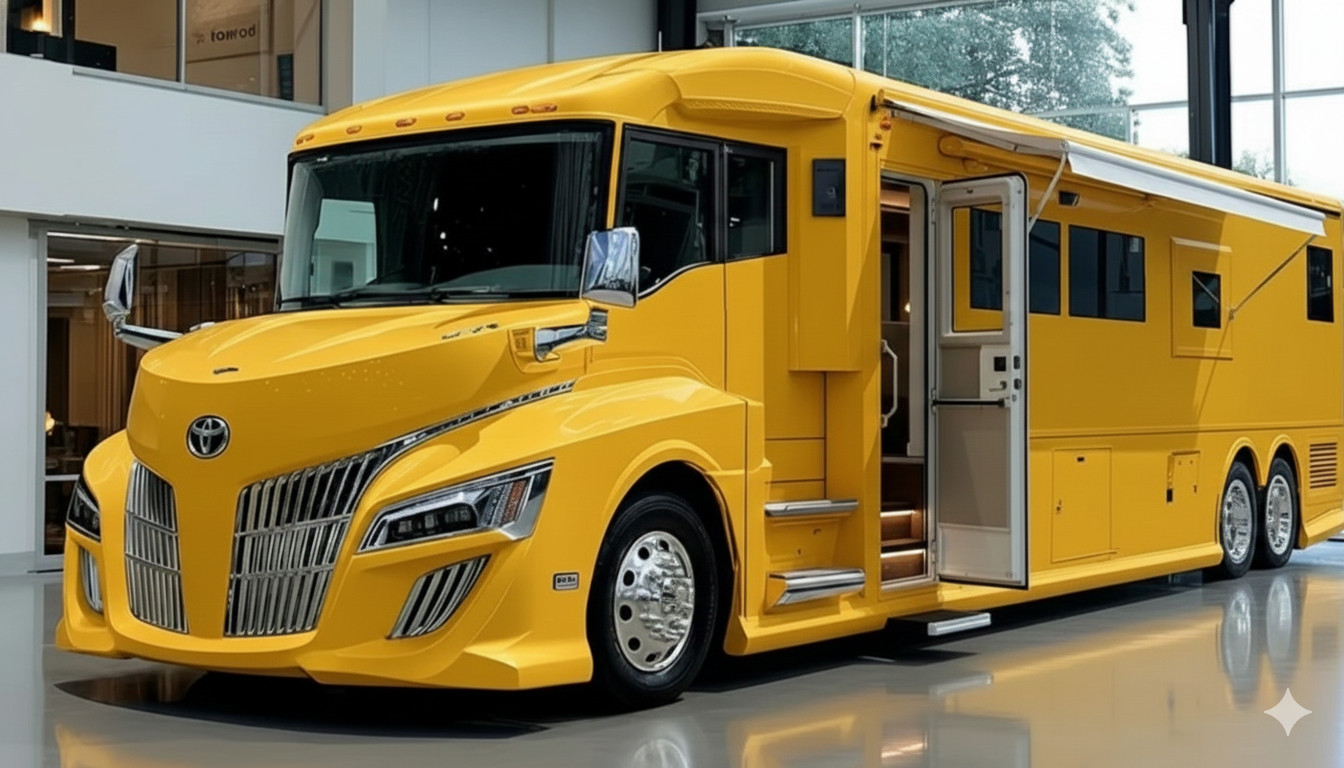
Toyota Imperial Cruiser MAX 2026! arrives as a statement: a luxury 6×6 hybrid expedition motorhome with 1,200-mile range that aims to let buyers live anywhere on Earth without surrendering comfort or safety. This report examines what the Imperial Cruiser MAX offers in design, powertrain, technology, safety, price, and real-world ownership considerations for U.S. buyers searching for an expedition-grade, long-range motorhome.
Quick overview: what the Imperial Cruiser MAX promises
The Imperial Cruiser MAX pairs military-inspired exterior engineering with penthouse-level interiors. Key selling points include a reinforced 6×6 chassis, a hybrid twin-turbo diesel V8 with massive torque, an adaptive air suspension, Starlink-grade global internet connectivity, and integrated solar plus regenerative energy systems. Toyota positions this model as an expedition platform that bridges the gap between rugged overland capability and year-round residential comfort.
Bold, expedition-ready design
Exterior design emphasizes purpose over fashion. The front fascia uses a reinforced steel bumper and triple-stack LED lighting. Ultra-high ground clearance, desert-rated cladding, and sand-track tires underline its off-road intent. The aluminum-alloy body reduces weight while a telescopic roof rack and exterior cargo modules keep long-trip gear accessible. Visually, it balances polar-capable toughness with curb appeal for premium RV resorts and urban stops alike.
Interior: a mobile penthouse engineered for long-term living
Interior layout is built around long-term occupancy rather than weekend use. Highlights include heated and ventilated Italian leather seating, smart glass windows with adjustable opacity, real wood paneling, and a climate system that auto-adjusts humidity and temperature to regional weather profiles. The living area features a king-size master bed, a modular lounge, a dedicated workstation, a gourmet kitchen with induction and convection cooking, and a full-size rainfall shower.
Design decisions favor durability and serviceability: built-in water purification, heavy-duty appliance mounts, and an onboard smart home hub that centralizes lighting, HVAC, and power management.
Powertrain and range: hybrid torque for extreme conditions
Propulsion blends a twin-turbo diesel 4.8-liter V8 with Toyota’s UltraTorque electric assist, delivering a combined output claimed at 835 horsepower and roughly 1,900 lb-ft of torque. Power flows through a 10-speed heavy-duty transmission to a 6×6 drivetrain with locking differentials and multi-terrain modes. An adaptive air suspension provides ground clearance modulation for dunes, rocks, or highway travel.
Energy architecture includes dual fuel reserves and a battery pack paired with a roof solar array and regenerative braking. Toyota projects a driving range up to 1,200 miles, making extended off-grid expeditions feasible with reduced refueling frequency.
Class-leading technology and connectivity
Navigation and driver aids are tailored for remote travel: a triple-screen panoramic cockpit display, satellite-based terrain mapping, and AI-assisted route planning. A caravan-support driving mode dynamically tunes speed, suspension, and traction to predicted surfaces.
On the living side, a smart home hub (voice or OLED control) manages appliances, water filtration, and power flows. Starlink-grade satellite internet promises global connectivity for remote work or streaming. Together, these systems create a closed-loop living environment designed for months on the road.
For background on satellite internet and connectivity trends, see Starlink: https://www.starlink.com and the Wikipedia overview on satellite internet: https://en.wikipedia.org/wiki/Satellite_internet.
Safety and expedition-class protection
Safety architecture exceeds typical RV standards. Structural measures include a 360-degree reinforced roll-cage. Active systems incorporate front and rear collision mitigation, radar terrain hazard alerts, and thermal-sensing night vision for wildlife and intruder detection. Ballistic-rated window shielding, emergency pressurized air filtration, and a panic-safe sealed room add layers of protection for high-risk environments.
These features are designed for buyers who plan remote travel where external assistance may be delayed; they also deliver insurance and resale benefits tied to documented safety systems.
Price, ownership costs, and value proposition
Base pricing in the U.S. is estimated at approximately $1,250,000. That places the Imperial Cruiser MAX against custom expedition builders and high-end conversions from established RV manufacturers. Ownership economics include:
- Lower relative fuel consumption for a vehicle this size due to hybrid assist, yet still higher operating fuel costs than consumer vehicles.
- Reduced utility costs because of integrated solar and efficient battery management for living systems.
- Higher insurance and storage fees tied to valuation and dimensions; however, advanced safety systems can mitigate premium increases.
- Potential regulatory and licensing costs in states with restrictive weight or size thresholds.
For buyers prioritizing long-term value, brand dependability and resale strength factor significantly. Toyota’s reputation for durability may contribute to better resale compared with bespoke one-off conversions.
Optional packages and extra costs to consider
- Extended 10-year Expedition warranty
- Rooftop autonomous drone launchpad and survey drone support
- Executive interior upgrades (marble surfaces, immersive audio)
- Arctic-rated heating systems and tactical exterior cargo boxes
- Offshore shipping and international import modifications
Storage and garage requirements in metropolitan areas are nontrivial. Potential buyers should budget for oversized vehicle storage or property modifications.
How it compares: who is the competitor?
The Imperial Cruiser MAX is positioned against turnkey expedition brands and custom armored or luxury RV builders. Comparable names include EarthRoamer, Global Expedition Vehicles, and large OEM-backed campers. Toyota’s angle blends a mainstream automotive brand’s engineering scale with expedition-specific features at a price that undercuts some ultra-rare custom rigs while offering factory-level integration.
Market context and verified signals
Expedition and luxury motorhomes remain a niche within the broader RV market, which has seen cyclical demand tied to travel trends and macroeconomic conditions. High-value expedition units typically command six-figure prices and attract buyers who prioritize self-sufficiency, security, and brand-backed service networks. For industry reporting and market context, see Reuters: https://www.reuters.com and AP News: https://apnews.com.
Related coverage and internal resources
For readers tracking broader cultural and technology trends that affect long-range travel and lifestyle, see these NewsTrendey resources:
https://newstrendey.com/entertainment/golden-globe-nominations-2026-complete-list/ https://newstrendey.com/entertainment/raul-malo-dies-at-60-tribute-legacy/ https://newstrendey.com/technology/5g-in-2026/
https://newstrendey.com/sports/timberwolves-vs-warriors-recap/
Why the Imperial Cruiser MAX matters
This model reframes what a motorhome can be by integrating extreme off-road capability, hybrid efficiency, and connected living systems. The core advantage is the removal of trade-offs: buyers do not have to choose between rugged expedition readiness and premium residential comfort. For those who value global reach, onboard safety, and long-range autonomy, the Imperial Cruiser MAX represents a compelling, if expensive, option.
FAQ
What is the driving range of the Toyota Imperial Cruiser MAX 2026?
Under combined hybrid fuel and battery reserves, the platform is rated for up to approximately 1,200 miles between major refueling or recharge events depending on terrain, load, and climate controls.
Is the Imperial Cruiser MAX street-legal in all U.S. states?
Street legality depends on local weight and dimension regulations. Buyers should verify state and local DMV rules and may need modifications or specialized permits in jurisdictions with strict oversized vehicle restrictions.
How much does the base model cost?
Estimated starting price in the United States is around $1.25 million. Optional packages and export or customization add to the total purchase price.
Does it include satellite internet and off-grid power?
Yes. The platform supports Starlink-grade satellite connectivity and integrates a roof solar array plus regenerative charging to maintain living systems off-grid for extended periods.
Who is the Imperial Cruiser MAX best suited for?
It is aimed at high-net-worth buyers who plan extended, remote travel or full-time mobile living and who prioritize safety, reliability, and global reach over upfront cost.
Satellite internet and global connectivity overview: https://en.wikipedia.org/wiki/Satellite_internet
General industry reporting and market context: https://www.reuters.com and https://apnews.com
Toyota corporate information: https://www.toyota-global.com
The Toyota Imperial Cruiser MAX 2026 is an ambitious union of automotive engineering and expedition-grade living. It targets a specific buyer: those who will pay a premium to remove the practical limits of long-range travel while keeping modern comforts and safety. If long-range autonomy, global connectivity, and armored-level protection are priorities, this model warrants serious consideration.
To follow developments and related reporting, consult NewsTrendey’s coverage pages and the linked resources above for real-time updates and deeper reviews.