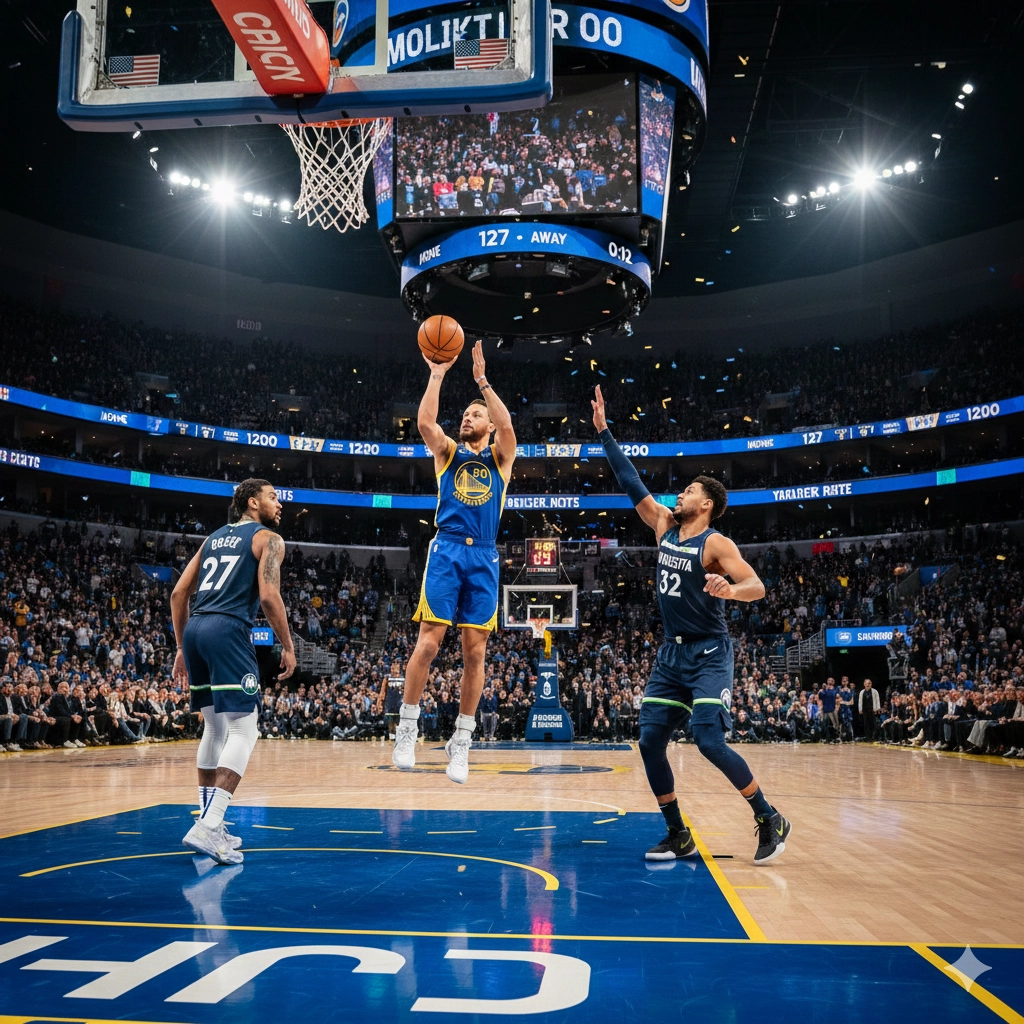
The phrase timberwolves vs warriors is already carrying weight in the Western Conference after Minnesota’s 127-120 win over Golden State on December 12, 2025. In a holiday-themed showdown at Chase Center, long-range shooting, interior finishes and late-quarter execution decided a game that featured lead changes, momentum swings and a showcase performance from Stephen Curry despite the loss. This Timberwolves vs Warriors full game recap and tactical breakdown highlights the key plays, player-by-player impact, and what both teams must adjust moving forward.
Quick result and headline numbers
Final score: Minnesota Timberwolves 127, Golden State Warriors 120.
- Julius Randle: 27 points, 9 rebounds, 6 assists, including two 3-pointers — Minnesota’s primary finisher and play-initiator.
- Rudy Gobert: 24 points, 14 rebounds on 11-13 shooting — dominant around the rim and efficient on high-percentage attempts.
- Stephen Curry: 39 points, 6 three-pointers — the game’s leading scorer and the most dangerous perimeter threat throughout.
- Records: Timberwolves improve to 16-9; Warriors fall to 13-13.
Game flow at a glance
The matchup was a microcosm of modern NBA tug-of-war: perimeter bombardment offset by paint dominance. Golden State relied on its motion offense and Curry’s creation from downhill drives and off-ball movement. Minnesota countered with physicality — Gobert controlling the paint and Randle forcing mismatches when defenders stepped out to contest shooters.
- First half: back-and-forth, many small runs, and both teams trading momentum. Curry returned from a brief absence and immediately influenced spacing and shot-making.
- Middle quarters: Minnesota found traction through offensive rebounding, second-chance points, and consistent midrange/post work by Randle.
- Fourth quarter: Minnesota’s bench and role players supplied enough energy to withstand a late Warriors surge. Minnesota’s late-game execution and rim protection were decisive.
Key turning points and momentum plays
Several sequences changed the game’s architecture:
- Gobert’s efficient interior offense: When Gobert was in rhythm (11-13 FG), Minnesota’s offense became compact and hard to contest. His presence forced Warriors defenders into difficult decisions: step out to close threes or protect the rim.
- Devin DiVincenzo’s fourth-quarter surge: DiVincenzo provided a big scoring lift late, forcing the Warriors to play with more pace. His scoring spree helped pull Minnesota back and finish the game ahead.
- Curry’s scoring but limited team spacing at times: Curry poured in 39 points, including 6 threes, but a lack of consistent secondary threats in key moments allowed Minnesota to strategically double or shade help into driving lanes.
- Offensive rebounding and second-chance points: Minnesota’s willingness to crash the glass repeatedly translated into extended possessions and swing possessions that ultimately separated the teams.
Player spotlight: Julius Randle and Rudy Gobert
Julius Randle demonstrated why he remains a multi-dimensional matchup problem. When defenders tried to step out and challenge shooters, Randle attacked the space with heady post reads and pick-and-roll finishes. His 27 points were not just volume — they were timely plays inside the paint and late-clock conversions that kept Minnesota in scoring position.
Rudy Gobert’s stat line — 24 points on 11-13 shooting and 14 rebounds — tells the story of a game where rim dominance mattered. His ability to finish around the rim and clean the glass limited transition opportunities for the Warriors and tilted several possessions toward Minnesota. In matchups where interior defense is critical, Gobert’s finishing and board control were non-negotiable assets.
Player spotlight: Stephen Curry and Golden State’s offensive identity
Stephen Curry finished with 39 points and six threes, an elite individual performance that masked some structural issues for Golden State. Curry’s pull-ups and floaters were a steady stream of offense, and his scoring often began Golden State runs. But the Warriors needed more consistent spacing and sturdier rim protection — especially when Gobert attacked the inside.
Curry’s 3-point accuracy remains elite, but the Warriors had stretches where shots off movement weren’t falling, and Minnesota’s physicality in the paint created a counterbalance. Golden State’s offense looks to run through off-ball motion, handoffs and Curry’s gravity. Against teams who can box the paint and pull opposing guards into help rotations, the Warriors must find secondary scoring sources to avoid a heavy reliance on Curry in the final minutes.
Tactical analysis: What worked for Minnesota
The Timberwolves’ win wasn’t an accident — it was the consequence of design and detail.
1) Attack the paint; force rotations
By consistently running ball screens and feeding Gobert inside, Minnesota forced Golden State defenders to make choices. When defenders stepped out to contest shooters, Gobert and Randle punished the paint with high-percentage finishes. That balance between interior attack and perimeter threat kept the Warriors off rhythm defensively.
2) Crash the offensive glass
Minnesota prioritized second-chance opportunities. Offensive rebounds extended possessions, created mismatches as defenses reset, and injected additional scoring runs at crucial junctures. These rebounds turned several close possessions into multi-point swings.
3) Bench contributions and depth usage
Role players stepped up when needed. Players like Devin DiVincenzo and Naz Reid supplied scoring that prevented Golden State from locking onto the primary scorers. The bench’s ability to make timely plays allowed Minnesota’s starters to operate without being overtaxed late in the game.
Tactical analysis: Where Golden State must improve
Golden State still showcased elite offensive traits, but exposed areas require attention.
1) Interior defense and rebounding
Against a big lineup with Gobert at the center, the Warriors struggled to control the glass consistently. Without Draymond Green’s typical presence and with Horford out, rim protection and defensive rebounding suffered. The result: extra possessions and easy points in the lane.
2) Secondary scoring consistency
Steph Curry’s 39 points were spectacular, but wins rely on balanced offensive output. Golden State needs the other perimeter options or wings to string together consistent scoring runs, especially when Curry’s looks are contested or he draws double teams.
3) Late-game execution on both ends
Execution in the final minutes — rotations, shot selection and limiting turnovers — made the difference. Minnesota executed cleaner in the late stretch; Golden State must refine late-quarter play calls and defensive communication to avoid recurring breakdowns.
Statistical context and what the box score hides
Raw numbers tell part of the story; context fills in the rest.
- Efficiency inside the arc: Minnesota shot a very high percentage in the paint, led by Gobert’s 11-13 accuracy. That high-percentage volume offsets Golden State’s perimeter output.
- Lead changes and possession battles: The game featured multiple lead changes and small-run swings, reflecting how possession-level plays (offensive rebound, foul calls, turnovers) created rhythm changes.
- Turnovers vs. contested shots: The Warriors had sequences where contested Curry drives forced risky passes. Minnesota’s ability to stay physical and challenge baseline rotations led to several contested attempts rather than comfortable drives.
Coaching decisions that mattered
Both head coaches made adjustments throughout the night, but a few decisions shaped the final result.
- Rotation tweaks: Minnesota’s allocation of minutes to role players with defensive reliability and offensive rebounding helped sustain pressure when starters rested.
- Pick-and-roll coverage: Minnesota’s switching strategy and Gobert’s positioning forced Golden State to move the ball more, buying time for help defense to arrive.
- Timeout and clock management: Golden State had opportunities to change momentum with timeouts in key stretches, but Minnesota often used its own late-game stoppages to set high-percentage plays.
How the result affects the Western Conference picture
This Timberwolves vs Warriors result has multiple implications:
- Minnesota (16-9) cements itself as a legitimate contender in the West with balanced offense, interior defense and the depth to survive runs.
- Golden State (13-13) now sits at .500 and faces questions about roster availability and sustainable defense without full strength personnel.
- The game is a reminder: Western Conference standings hinge on consistent two-way play. Teams that can protect the rim and hit open threes will rise; those that are lopsided will drift near the middle.
Notable individual sequences and micro-analyses
Breaking down small but decisive moments provides clarity on the outcome.
- Stretch where Curry scored 9 in a quarter: Curry’s ability to finish through contact and with floaters contributed to a spurt that briefly gave Golden State a boost, but it didn’t translate into a lasting lead because of rebounds and missed peripheral defense.
- Late offensive rebound that became a Randle bucket: An offensive board extended a possession and turned into a high-percentage post touch for Randle — a micro-moment illustrating Minnesota’s crash-and-convert philosophy.
- De’Anthony Melton and Buddy Hield spacing: Minnesota’s wings opened up corner and catch-and-shoot opportunities, which kept the defense honest and prevented overloading into the paint.
What the numbers predict going forward
Look at a few predictive angles:
- Warriors’ dependency on Curry: Prediction models frequently penalize teams with extreme usage concentration. If Golden State cannot build reliable scoring around Curry, their consistency over a long season will suffer.
- Minnesota’s defensive ceiling: With Gobert anchoring the paint and Randle’s playmaking, Minnesota projects as a top-10 defensive rebound team and top-12 defensive unit if they maintain this chemistry.
- Playoff implications: Both teams are positioned to jostle for home-court advantages. Minnesota’s depth gives them a slight edge in a seven-game series against perimeter-heavy teams; Golden State will need to lock down rotations defensively.
Quotes and reactions that matter
Postgame vibes from the floor and announcers highlighted themes of resilience and the high level of competition. Curry’s return and immediate scoring demonstrated his durability as a primary engine; Minnesota’s rotation and two-way effort confirmed their depth is a real advantage.
Five tactical adjustments each team should prioritize
Minnesota — continue doing this
- Keep prioritizing offensive rebounds and rim touches for Gobert and Randle.
- Space the floor with catch-and-shoot wings to punish help rotations.
- Use bench depth to sustain defensive energy late.
- Exploit mismatches created when Warriors over-help on drives.
- Maintain high-effort transition defense to limit Curry pull-ups off the break
Golden State — changes to consider
- Emphasize interior defensive rotations and stronger box-outs without key bigs available.
- Generate more drives from off-ball movement to create secondary scoring opportunities.
- Increase cutting and baseline activity to contest interior help defenders.
- Stagger minutes to ensure a defensive presence when Curry rests.
- Refine late-clock play calls to reduce contested, low-efficiency attempts.
How fans and bettors can read this game
For bettors and season-ticket holders, a few practical takeaways:
- Look for Minnesota’s small-lineup matchups where Gobert and Randle can punish mismatches; these are favorable betting environments for over/under points when Gobert is efficient.
- When Curry posts 30+ games, Golden State still covers spreads against teams that struggle to close out perimeter shooters — but not when offensive boards are a significant swing factor.
- In futures markets, Minnesota’s win strengthens their case as a higher-seeded team in the West if they sustain defense; Golden State’s record around .500 suggests volatility in their seeding trajectory.
How this compares to historical matchups
Minnesota’s recent success vs Golden State continues a competitive trend. Historically, matchups between a perimeter-heavy Warriors squad and an interior-focused Timberwolves team hinge on rebounding and forcing contested jumpers. When the Wolves win the glass battle and finish on the interior, they create a consistent blueprint for victory.
What to watch next
Key items on the radar over the coming weeks:
- Golden State’s health updates and rotation experiments; how the team adjusts dribble-handling and defensive schemes without their primary interior defenders.
- Minnesota’s ability to maintain interior dominance on the road — repeatable success away from home will validate their current standing.
- Whether Curry’s scoring outbursts are augmented by better secondary scoring or if the Warriors remain Curry-dependent late in games.
Sources, further reading, and fact-checks
For further box-score detail, play-by-play logs and analytics from this matchup, consult the official game recap and play-by-play: espn. General NBA schedules and standings can be referenced at nba. Additional context on team histories and roster composition is available on Wikipedia: Minnesota Timberwolves and Golden State Warriors. Reuters coverage on broader NBA trends can be found at reuters.
For related site coverage, read the Golden Globe Nominations 2026 feature and the Raul Malo tribute piece on NewsTrendey as part of our broader editorial perspective: Entertainment golden globe nominations 2026 complete list and Raul Malo dies at 60 tribute legacy.
Conclusion and call to action
The Timberwolves’ 127-120 win over the Warriors reaffirmed Minnesota’s blueprint for success: control the paint, crash the boards, and convert efficiently around the rim. Golden State still boasts one of the league’s most dangerous scorers in Stephen Curry, but consistent secondary scoring and interior defense will determine their path forward. For regular updates, analysis and continued coverage of timberwolves vs warriors and the broader NBA landscape, follow NewsTrendey’s sports section and bookmark our homepage at Newstrendey .